
Summary:
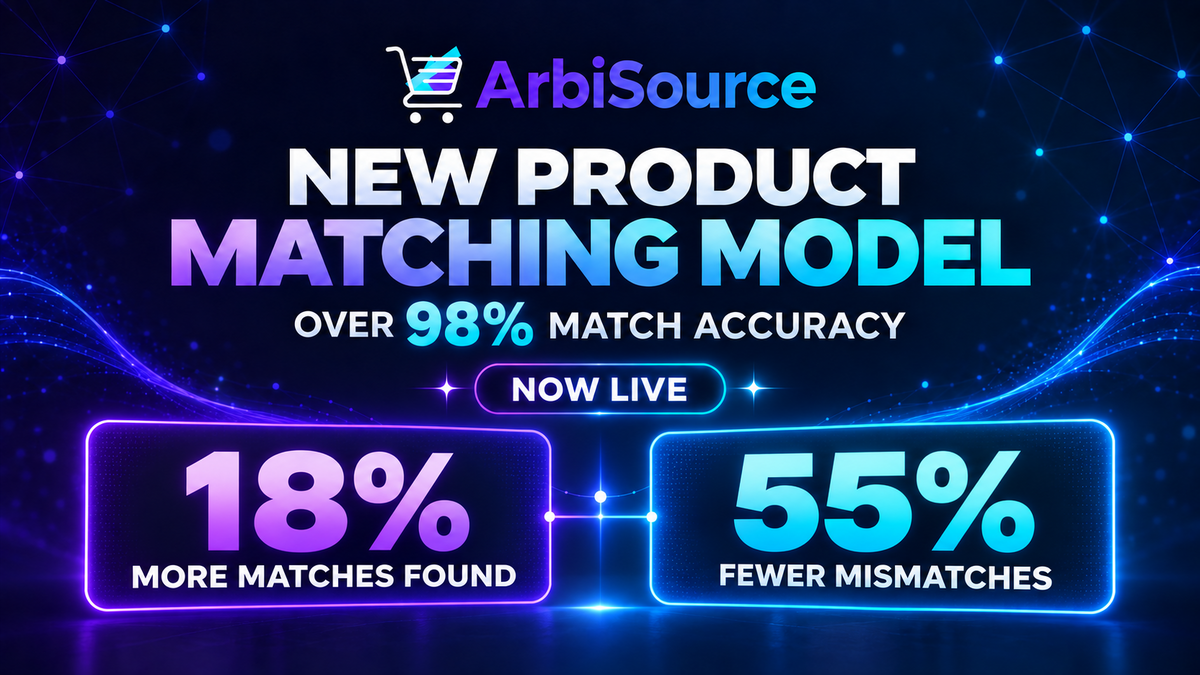
ArbiSource has launched a rebuilt product-matching model that uses structured product evidence alongside image matching and safeguards. Testing found 18% more genuine matches, 55% fewer mismatches and over 98% overall accuracy. The model is live for newly compared products, while existing products will be recomputed gradually over the coming weeks.
We have rebuilt one of the most important parts of ArbiSource from the ground up: the system that decides whether a retailer product and an Amazon listing are the same product.
Our new title-matching model is now live and is being used for all newly compared products.
In our testing, the new system:
- Found 18% more genuine matches than the previous model
- Produced 55% fewer mismatches
- Helped bring overall product-match accuracy to over 98%
These improvements mean ArbiSource can identify more of the opportunities that were previously missed, while being substantially better at rejecting Amazon listings that look similar but represent a different product.
Why Product Matching Is Difficult
Product titles are rarely written consistently across different websites.
A retailer might use a short title containing only the brand and product name, while the corresponding Amazon title includes colours, sizes, quantities, compatibility details, marketing phrases and dozens of additional keywords.
The opposite can also happen. Important details such as the pack quantity or model number may appear in the retailer title but be missing from the main Amazon title.
Small differences can also completely change whether a match is correct:
- A single item compared with a multipack
- Two different model numbers from the same product range
- A medium item compared with an extra-large version
- Two products with similar names but different sizes, colours or specifications
At the same time, being too strict causes genuine matches to be rejected simply because one website omitted a detail or described the product differently.
The challenge is not just finding similar titles. It is understanding which differences matter.
What We Rebuilt
We have rebuilt the surrounding matching process so it can make better use of structured product evidence, including:
- Pack quantities and total product counts
- Product sizes and equivalent units of measurement
- Model numbers and identifiers
- Clothing and footwear sizes
- Colours, flavours, scents and named variants
- Product types and common bundle formats
- Amazon size and title-differentiation information
The title model works alongside our image-matching system and a set of carefully tested safeguards. No single score is treated as perfect evidence on its own.
The Results
We tested the new system against a large collection of real retailer and Amazon product comparisons, including manually reviewed examples and previously unseen products from different retailers and categories.
Compared with the previous title-matching model, the new system found 18% more correct matches and reduced incorrect matches by 55%.
Our wider testing puts overall product-match accuracy at over 98%.
Results will naturally vary between retailers and product categories, but the improvement was not limited to one type of product or a small collection of hand-picked examples. We evaluated the model across a broad range of real-world data and repeatedly tested changes against previously labelled products to protect against regressions.
Does This Eliminate Every Mismatch?
No. Product matching is not a problem where it is realistic to promise 100% accuracy.
Some retailers provide very little identifying information. Different products can share almost identical titles and images, while the same product can be described very differently across two websites. Incorrect barcodes and incomplete Amazon data can make these cases harder still.
It would be possible to eliminate more mismatches by rejecting every uncertain comparison, but this would also remove a large number of genuine matches and opportunities.
Instead, our aim is to strike the best practical balance: find as many genuine matches as possible while rejecting incorrect products whenever there is meaningful evidence of a difference.
There will still be occasional mismatches. Some genuine matches will still be missed. However, both now happen substantially less often than with the previous model.
How The Rollout Works
The new model is already active for all newly compared products.
Existing products will be recomputed gradually over the next several weeks.
This means you may see improvements on some retailers before others. An existing product will not necessarily change immediately, even though the new model is live.
You do not need to change any settings or rerun your existing scans. Updated matching will be introduced progressively as products are recomputed and new products are discovered.
What This Means For ArbiSource Users
The practical result should be:
- More genuine Amazon matches being found
- Fewer profitable opportunities being missed
- Fewer incorrect products appearing in scan results
- More dependable confidence scores when reviewing opportunities
Product matching sits at the foundation of almost every sourcing result in ArbiSource. Rebuilding it has been a substantial project, but it gives us a stronger base for further improvements in the future.
The new model is live now, and the recomparison of existing products is underway.


